
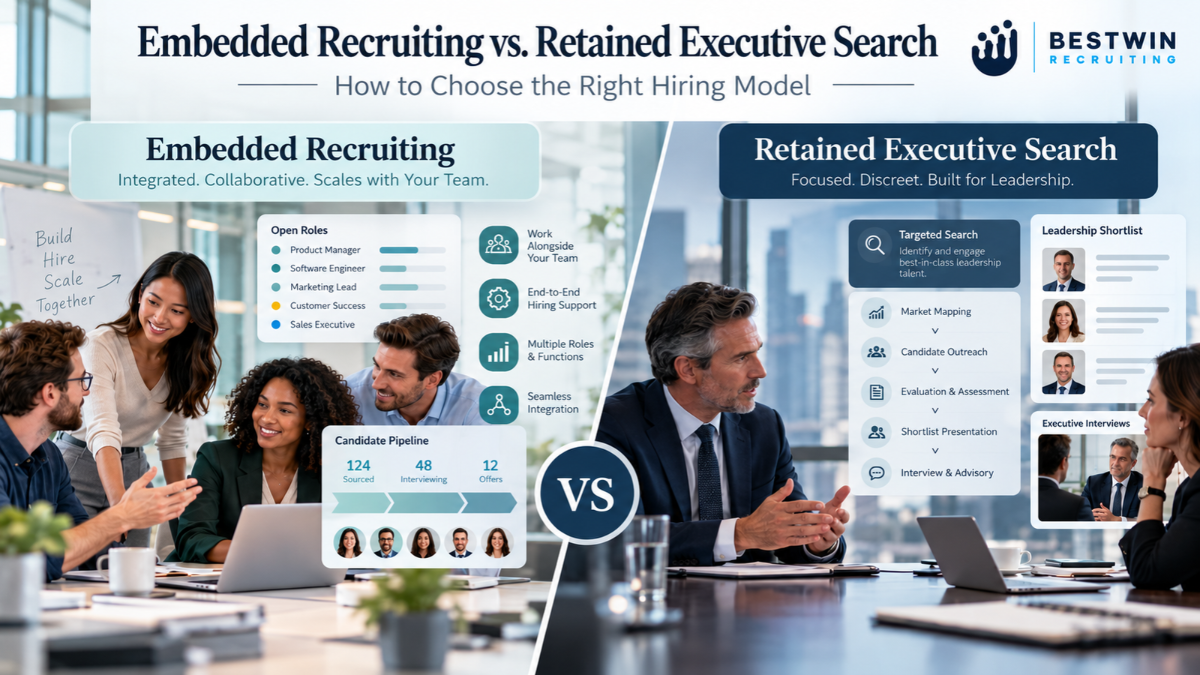
When it comes to recruiting, there are two different approaches you can choose from: Embedded Recruiting and Retained Executive Search. There are two hiring models available when it comes to recruiting: Embedded Recruiting and Retained Executive Search.
The recruitment model you select can have a huge impact on your hiring efficiency, cost, and candidate pool. Organizations that are recruiting for one critical role might have different requirements than those who are filling multiple roles in various departments.
There are two choices that are worth being familiar with: embedded recruiting and retained executive search. While both can be used to search for specific job candidates, they differ in the allocation of recruitment resources, the nature of the engagement process, and what occurs at the end of the recruitment task. When assessing recruitment solutions, it is important for employers to be aware of these differences and how this will support their hiring needs, internal resources, and business goals.
What Is The Difference Between Embedded Recruiting And Retained Executive Search?
Embedded recruiting is dedicated recruitment support that is closely integrated with the internal team of the organization. An embedded recruiter can assist with several positions, streamline recruitment processes, and ensure a steady stream of candidates, etc., depending on the terms of the agreement.
Generally, the retained executive search process is built around a particular senior or specialized search. A client hires a search company to do a specialized search, develop a short list of candidates, and assist in the selection.
The difference is the extent of the engagement. Embedded recruiting is sometimes packaged to give consistent capacity for recruiting, while retained executive search focuses on delivering a clear search assignment.
Both strategies can include screening, outreach, and direct communication with the hiring entity, in a proactive manner. Better candidates or faster hiring is not automatically guaranteed by either model – results of the process rely on the type of the position, market, strategy, and execution.
Comparing The Two Recruitment Models
This section compares the two recruitment models. This section compares the two recruitment models.
Resource | Embedded Recruiting | Retained Executive Search |
Goal | Continuous recruitment assistance | Specific search for a specified role |
Excessive hiring or continued hiring | Appointing a specific executive or specialist | |
Fees | Frequently an engagement fee | Usually a retainer fee based on milestones agreed to |
May be used for multiple roles and pipelines, or limited to particular roles and pipelines | Narrowed to needs of the role(s) assigned for the search | |
Internal collaboration | Interdependent with client's team | Typically structured around the search engagement |
Research records | Ownership and access are dependent on agreement | Ownership and access are dependent on agreement |
Best potential fit: Organizations with ongoing hiring needs | Organizations with a special hiring need for a specific position: |
Each provider may have specific services offered. Before signing an agreement, employers should verify fees, deliverables, exclusivity, and how fees, work, and/or any research will be reported and owned.
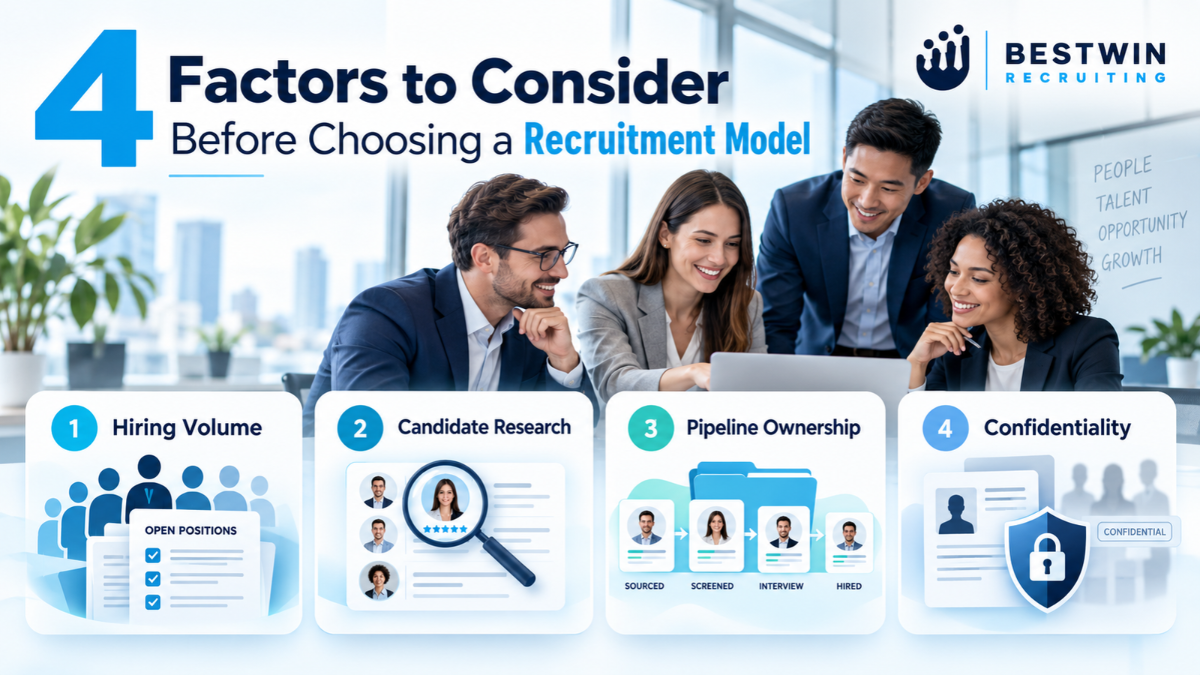
Four Factors To Consider Before Choosing a Recruitment Model
There are four factors that must be considered before selecting any recruitment model. Before choosing any recruitment model, there are four factors to consider.
While the seniority of the position is important, it is not the only factor that determines the best recruitment approach. Employers can use the following four practical considerations to help them make a decision.
1. How Many Positions Need to Be Filled?
Always think outside the box when it comes to looking for a job. Does the organization have one job to fill, or do they expect to hire in several teams within the next few months?
A business that is seeking one particular executive role might be better suited to a focused search engagement. If there are several vacancies to attend to and coordinate, an embedded arrangement might be considered.
The number of workers expected to be employed should be realistic. A business with sporadic recruitment requirements might not need to invest in a continuous capacity, and one with regular recruitment load may find it difficult to coordinate multiple searches.
2. How Much Candidate Research Is Needed?
Certain positions can be filled with existing candidate pools and outreach efforts. Others need to do more market research, especially if the skills needed are in short supply or if there is very specific experience.
Employers need to determine if it's important to keep an overall picture of the talent market or if they want to get a detailed picture of the landscape or just a very targeted search of a specific talent pool.
The depth of research required affects the scope, time, and resources of the project. A well-defined research plan is also useful to the client to understand what the recruitment provider will provide.
3. Who Cares for the Research and Candidate Pipeline?
Once a position has been filled, the research done to recruit the candidate can still be of value. Past interaction with candidates, market knowledge, salary data, etc., can lead to better hiring decisions.
Before selecting a model, make sure to discuss what will happen to candidate information and research materials at the conclusion of the engagement. Inquire about what records will be maintained in your organization, who is operating the systems, and how personal data is being kept or eliminated.
The agreement should include documentation of ownership, access, and reuse arrangements, which should be managed based on applicable privacy requirements.
4. Is Confidentiality Required to Perform the Position?
Discretion may be required with some hiring assignments due to the fact that a replacement hasn't been named, an organizational shift is still under review, or a sensitive leadership assignment is taking place.
Under such conditions, it is important to set up a confidentiality requirement prior to the search process. Employers need to think about who will have access to information regarding the candidate, how the information will be communicated, and who will be given the information.
There are some confidential appointments that a retained search might be suitable for, though the engagement's nature does not ensure that they are confidential. Trust is dependent on the protocols, contractual safeguards, and actions of all parties involved.
Why Seniority Alone Should Not Determine the Hiring Approach
If you're looking to hire a new employee for your company, you shouldn't judge your candidate solely by their seniority.
A senior title does not necessarily reflect complexity, but it does give an employer some idea of what the challenge is.
A senior position may also form part of a wider recruitment initiative that is seeking to fill multiple related roles – the same recruiter could be helping with multiple senior positions. On the other hand, if the position is middle-level, it may be a niche skill or confidentiality requirements that make it more challenging to find.
Employers should instead consider the actual requirements of the position, and not simply assume that a particular recruitment model would be suitable for a particular job level.
Think about the availability of qualified candidates, the number of related vacancies, the need to make the appointment, and the impact of hiring the wrong individual. These factors are more useful in determining the amount of recruitment support necessary.
A good assessment at the outset can also help avoid confusion about the search focus, what is needed for the research, and what will be delivered.
What Happens To Recruitment Research After a Hire?
A common factor that is not often thought of is what happens once a candidate accepts an offer.
When assigned to a recruitment project, the team can create a list of candidates, find suitable employers, collect data on the market, and build connections with individuals who are not actively seeking a new role.
Appropriate maintenance of these resources and permission to use them can provide information to subsequent hiring activity.
An ongoing recruitment arrangement may ensure continuity between recruitment cycles, and a dedicated executive search may instead focus on one recruitment. But both models do not automatically decide who is the owner of the research or if the research can be reused.
Before the engagement, discuss with the provider:
What information and outputs will be shared during the recruitment process.
How candidate information will be kept and secured.
If market research can help with future vacancies.
Reporting to be provided during the engagement.
How records are disposed of when the contract is terminated.
Having these issues in place beforehand helps employers see the long-term benefit of the recruitment effort and avoid future confusion.
How Recruitment Fees and Engagement Structures Affect Results
Recruitment fees and the structures of engagement can impact results. The effects of recruitment fees and engagement structures on results.
Recruitment fees can affect the monetary dedication and motivations of a recruiting relationship. It's therefore crucial to comprehend the payment structure when evaluating a recruitment provider.
Usually, the hiring process for retained executive search has an agreed-upon fee that is paid in stages, often related to the beginning of the assignment and stage milestones. Specifics will vary from provider to provider, depending on their contract.
Oftentimes, embedded recruiting will have a recurring fee for the agreed services and capacity. It can be more predictable in terms of budget when the organization has ongoing hiring needs, depending on the extent and time of the hiring.
Other recruitment structures might charge a fee if a candidate is recruited successfully. These models have various financial properties and should be evaluated against the services offered.
Employers shouldn't just judge on the headline price; rather, they should assess what is likely to be delivered, the availability of the recruiter, the candidate's research and reporting, the exclusivity of the placement, and make sure there is a backup plan as well.
If requirements or conditions change, request providers to clarify the full price, payment timeline, and conditions. If the agreement is transparent, it is easier to enable consistent comparison of proposals.
When Should a Business Consider Each Model?
The best recruitment model to use is dependent on the situation and the type of position being filled.
When Embedded Recruiting May Be Suitable
Embedded recruiting may be appropriate when recruiting could be considered in situations where:
Consider embedded recruiting if a company has multiple job openings, anticipates ongoing recruiting needs, or a need for support that can be integrated into the company's internal recruiting process.
It is also appropriate if continuous recruitment coordination and developing of a candidate pipeline are essential to the organization.
When Retained Executive Search May Be Suitable
Here are some situations in which a retained executive search firm can be a good choice. Consider when retained executive search may be appropriate.
Retention is the most suitable approach when an organisation has a dedicated process for appointing a senior or more specific or technical role. This may involve assignments that involve targeted candidate research, planned evaluation and selective communication. Depending on the circumstances and the capabilities of the provider, a confidential appointment can also involve a specialist search arrangement.
When Neither Model Is Ready to Proceed
The issue may not be the recruitment model, but a confusing job opening. Regardless of the structure, if the responsibilities, reporting relationships, compensation expectations, or selection criteria have not been identified, the search will be difficult.
Before entering a recruitment engagement, the position and realistic requirements need to be clarified first.
If companies are interested in recruitment options, they can check out Bestwin Recruiting for further information about the company and inquire about their recruitment needs.
Frequently Asked Questions
What Is Embedded Recruiting?
Embedded recruiting is a recruitment support that becomes part of an organization's internal team. Depending on the scope of engagement, the following may be included: Several vacancies are covered, recruitment coordination, and ongoing sourcing of candidates.
What Is Retained Executive Search?
Retained Executive Search consists of a two-part process. Retained Executive Search is a two-part process.
Retained executive search is a type of search service in which a company hires a search firm to search for a specific executive or specialist role. The fees and the deliverables are agreed upon in the engagement agreement.
Is Embedded Recruiting More Affordable Than Retained Search?
There is no general 'best' price for either model. The total cost will depend on the number of people hired, time of engagement, the nature of the search, and rates paid and the services provided. Employers need to take a look at the expected cost, and then at their recruitment needs.
Can Embedded Recruiting Help With Senior Positions?
It can, depending on the expertise of the provider, the extent of the involvement, and the needs of the job, be a one-time action or a continuous procedure. An embedded arrangement is not always suitable for the senior.
What Should Employers Ask Before Signing a Recruitment Agreement?
Employers should define the scope, structure of fees, scope of services, reporting, exclusivity, confidentiality, research ownership, handling of candidate data, and termination conditions.
How Can Businesses Choose the Right Recruitment Partner?
First is to establish the problem, the number of hires needed, the skills required, and the budget to hire. Then compare providers according to relevant experience, communication, transparency of processes, and services they can show they are able to deliver.
Conclusion: Choose A Recruitment Model That Fits Your Hiring Needs
Embedded recruiting and retained executive search are two different types of recruiting needs. If you're looking for ongoing recruitment assistance, embedded recruiting can be a better fit, whereas retained executive search can be an excellent solution for targeted recruitment for a specific executive or specialist role.
The most useful decision is based on the volume of the recruitment, the difficulty of market candidates, confidentiality, the research needs, and the financial make-up of the engagement. Employers should also set clear expectations regarding deliverables, reporting, and handling of candidate information.
Defining them prior to hiring a provider will help ensure businesses make informed decisions when recruiting and put their hiring process on a solid foundation. Check out Bestwin Recruiting for more details about the organization's recruitment offerings and talk about the hiring requirements for your organization.