
Fractional recruiting is becoming a trend in the job-hiring world. Fractional recruiting is becoming a popular hiring strategy. The process of growing a company can result in a hiring challenge. You need a bunch of skilled people to fill in critical positions, but you may not need to have a full-time person in recruitment. Recruitment agencies will help, but the costs can be high when you are looking to recruit for several positions for an extended period.
Another approach is to implement a Fractional Recruiting team - this means you gain access to professional recruiting expertise without having to make the commitment to establishing a full-time in-house recruiting team, on a part-time or permanent contract basis.
This can be beneficial for startups and small businesses that may have different requirements for staffing, and can assist them to stay in line with the business goals when hiring. Knowing what fractional recruitment is, what it entails, how it's paid, and when it's appropriate can make it easier for your company to determine the best way to approach recruitment.
What Is Fractional Recruiting?
Fractional recruiting is a business model in which businesses hire a professional recruiter for a specific time or for a specific service contract, instead of a full-time recruiter. The recruiter will get to decide on hiring preferences that can include the critical roles of sourcing candidates, reviewing applications, initial screening, organizing interviews, conducting the hiring process, and assisting with the offer discussion.
The recruiter can work a specific number of hours per week, work on certain hiring projects, or be hired on an ongoing basis for a monthly fee. A fractional recruiter might be more closely connected to the company's recruitment process than a recruiting agency that might be more focused on filling a position. They can educate themselves about the business, the hiring manager's expectations, and be consistent with several searches.
If a tech company is looking to hire a software engineer, a product manager, and a sales representative, it may not require a recruiter all year long. Ongoing support can be offered via fractional recruiting until the jobs are filled. This is dependent on the provider. Before starting, it is necessary to establish the duties, availability, reporting requirements, and payment terms of the recruiter.
Understanding How To Utilize Fractional Recruiting Services
The first step of fractional recruiting is to assess the needs of a company with respect to hiring. The recruiter and business determine the jobs that are targeted, the criteria used to determine success, and the process used in recruiting.
Identify The Hiring Needs
The company is aware of the types of jobs that are available, skills required, salary ranges, when to hire, what the business results will be if they hire, etc. They both agree on the engagement plan, such as hours/load, scope of work, communication plan, fees, and expectations.
Create The Candidate Sourcing Strategy
The recruiter drafts or refreshes job descriptions, identifies who to target, contacts them, reviews resumes, and filters them based on the requirements.
Interview Process Of The Candidates
The recruiter also schedules, solicits feedback, and tracks the candidate and helps the hiring manager keep the momentum going. Regular updates reveal which positions are moving forward, which candidates are dropping out, and if there is a need to change the hiring approach.
The process can be customized for the company's internal systems.
A fractional recruiter can be integrated with an existing applicant tracking system (ATS) or make use of the approved methods of communication with the company, and be part of the hiring meetings as well.
The employer has the final say, and the agreed activities for the recruiter are under their control.
Numerous Advantages To Fractional Recruiting
When a company has a need for professional hiring help but doesn't need to hire a full-time recruiter, fractional recruiting may come in handy. It relies on the hires, the nature of the position, recruiter skill, and the way the company deals with the process.
Flexible Recruiting Capacity
The number of employees a business requires changes with the company's growth, new product launches, expansion into new markets, or your company's downsizing.
A flexible recruiting arrangement enables a company to add support when there's more recruitment activity or if priorities shift. The contract should contain the procedures for workload/scope of service and hours adjustments.
How You'll Get To Use Recruiting Know-How
An experienced recruiter can bring value in the following ways: Structured sourcing approaches, candidate evaluation procedures, and knowledge of the jobs that they specialise in.
It can be particularly helpful when applying for a job that has a specific need and not just an open application.
There is no universal definition of the same type of fractional recruiter, nor is there one type of recruiter that is the right fit for all roles, industries, and hiring processes.
Better Uniformity Of Recruitment Practices
In a chaotic recruitment process, managers must manage to keep track of the candidates they're trying to recruit, schedule meetings, communicate with them, and deliver feedback about their candidates, while doing their regular work at the office.
A fractional recruiter will provide you with the help of uniform processes,
keeping track of which candidates progress, organizing interviews, and communicating with hiring managers.
The outcome is subject to the clarity of roles along with the internal teams' commitment to giving it timely feedback.
Support Without Immediate Full-Time Headcount
A business may need recruiting assistance at a certain stage of its development but not enough business to merit the hiring of a full-time recruiting position. If not, you may want to explore fractional recruiting instead of committing to it up-front. The company can see what they need for ongoing hiring needs before making the decision to form an in-house recruiting team.
An Improved Visibility Of The Hiring Activity Is Offered.
Recruitment reports can give managers a heads-up on available positions, how they responded, how they progressed through the interview process, whether they accepted the offer, and how long it took them to go through the different stages of the hiring process.
When the real performance of the pipeline is taken into consideration, not assumptions, these metrics can be used to narrow the recruitment and decide on recruitment.
What Is The Price Of Fractional Recruiting?
The hiring price of fractional recruiting is dependent upon the position type, location, and position qualifications. The costs vary based on how experienced the recruiter is, the number and nature of the positions, the size of the task, the duration of the contract, and other services provided.
Examples of common pricing models are:
Hourly basis: The company is paying for a predetermined number of recruiting hours.
Regularly paid fee by the company for a fixed amount of recruiting assistance.
Project-based pricing: A fixed price for a particular recruitment project or deliverable is agreed.
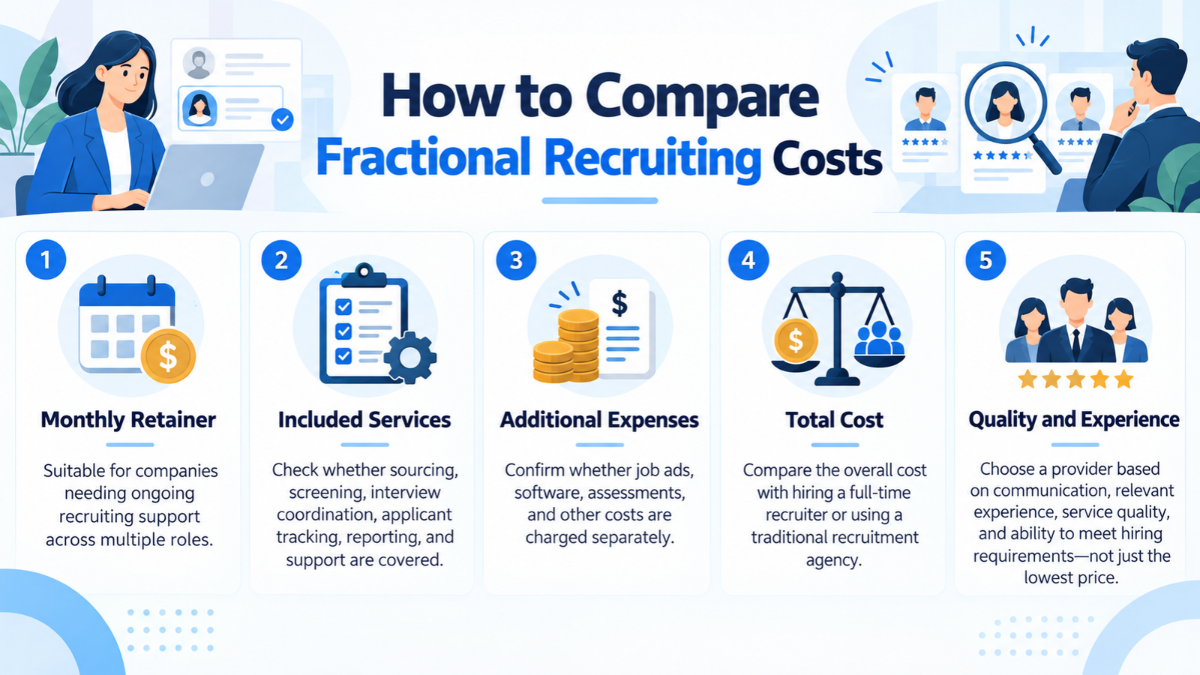
How to Compare Fractional Recruiting Costs
When comparing fractional recruiting costs, consider these key points:
Monthly Retainer: Suitable for companies needing ongoing recruiting support across multiple roles.
Included Services: Check whether sourcing, screening, interview coordination, applicant tracking, reporting, and support are covered.
Additional Expenses: Confirm whether job ads, software, assessments, and other costs are charged separately.
Total Cost: Compare the overall cost with hiring a full-time recruiter or using a traditional recruitment agency.
Quality and Experience: Choose a provider based on communication, relevant experience, service quality, and ability to meet hiring requirements—not just the lowest price.
Fractional Recruiting vs. In-House Recruiters vs. Recruitment Agencies
These three models can serve different business needs. The right choice depends on the company's hiring volume, budget, internal capabilities, and desired level of control.
Factor | Fractional Recruiting | In-House Recruiter | Traditional Agency |
Commitment | Defined flexible engagement | Ongoing employment | Usually tied to a search or service contract |
Cost structure | Hourly, retainer, or project fee | Salary and employment expenses | Often a placement fee or agreed service fee |
Internal integration | Can work closely with the team | Direct internal team member | Depends on the agency relationship |
Hiring workload | Agreed scope and capacity | Depends on the employee's workload | Often focused on contracted vacancies |
Best fit | Variable or moderate recruiting needs | Sustained, ongoing hiring needs | Specific searches or specialist candidate access |
A fractional recruiter may suit a company that needs recurring support but cannot justify a full-time role. An in-house recruiter may be more suitable when recruiting remains a continuous, high-priority business function.
When Should a Business Hire a Fractional Recruiter?
If hiring demands are appropriate, but do not require full-time employment of a professional recruiter, fractional recruiting may be an option. Planning to scale up your startup may necessitate hiring technical, commercial, or operational staff members and keeping other business functions.
A small to medium-sized business may be a business that is growing and perhaps may have multiple positions open and not have enough hiring personnel to cover the cost of having a full-time recruiting person on board for the entire year.
New Market Expansion Firms
Firms might be limited in recruiting ability while developing their future recruiting program in a new market.
If recruitment resources are scarce, managers may need help in coordinating interviews, providing updates to potential hires, and overseeing the recruitment process.
For businesses that have very specific job openings, special sourcing and evaluation of candidates are necessary. You can use the help of a qualified recruiter to greatly narrow down your search to find the perfect candidate.
Fractional recruiting might not be the best option when the firm requires a lot of recruiting activity on a daily basis, is looking for hiring at multiple sites, or is seeking to use the service more than it is contractually committed to.
If the company has an idea of the number of tasks they will need to do, and how much time they will need to respond to them, this is the best model to go with.
How To Choose The Right Fractional Recruiting Partner
Cost is not the only factor to consider when selecting a recruiting partner. The provider needs to be aware of the company's recruitment requirements and have a realistic implementation plan. The first thing you need to do is get a feel for the recruiter's background and any experience they have had in the same role and/or field. Ask them where they have been finding candidates, how they are screening them, how they reach out to them, how they schedule and communicate with hiring managers during interviews, etc.
Technology and data management also come into play. Identify which applicant tracking system(s) and communication systems will be employed, who will have access to the information about candidates, and how confidential information will be guarded.
Lastly, set agreed and measurable performance indicators. These might be time to fill, qualified candidates presented, interview conversion, offer acceptance, and feedback from the hiring manager. Metrics should be interpreted in context since they could be affected by compensation and market factors, role complexity, etc.
The best recruiting partnership is one that has the ability to communicate, be realistic about what to expect, and be transparent about the reporting instead of guaranteeing that candidates will come through quickly or on full quality.
FAQS:
What is the difference between fractional recruiting and a fractional recruiter?
Fractional recruiting refers to the service or hiring model. A fractional recruiter is the professional who provides recruiting support through that arrangement. The precise scope depends on the engagement.
Is fractional recruiting suitable for startups?
Yes, it can suit startups that need professional hiring support but are not ready to employ a full-time recruiter. Its suitability depends on the number of vacancies, hiring urgency, budget, and expected workload.
How is fractional recruiting usually priced?
Providers may charge by the hour, through a monthly retainer, or on a project basis. Companies should request a clear breakdown of included services and any additional expenses before signing an agreement.
Can a fractional recruiter manage the entire hiring process?
Potentially. Depending on the agreement, a fractional recruiter may handle sourcing, screening, interview coordination, candidate communication, pipeline management, and offer support. The employer generally remains responsible for final hiring decisions.
Is fractional recruiting better than using a recruitment agency?
Neither model is universally better. Fractional recruiting can provide ongoing involvement in a company's hiring process, while an agency may be suitable for individual vacancies or specialized searches. Compare scope, fees, candidate access, and service expectations.
Can fractional recruiting work alongside an internal HR team?
Yes. A fractional recruiter can complement an existing HR team by managing agreed recruiting activities, providing additional capacity, or supporting searches that require specialized experience. Responsibilities and reporting lines should be defined at the start.
Develop A Recruitment Strategy For Your Business
The recruiting model is a match between the recruiting ability and business needs. Depending on the nature of the company, each of these full-time recruiters, traditional agency, and fractional recruiting partners has its own set of advantages and disadvantages.
When hiring a full-time recruiting team isn't an option, fractional recruiting could be a better fit for a company looking to leverage a seasoned recruiter who works part-time. With a clear scope, the right skills, and reporting, they gain improved insight to hire the right people and have a more structured recruitment process.
If your business is looking to reach the next phase in its growth, Bestwin Recruiting is an excellent place to start to understand the support available in the recruitment space and what you should focus on when hiring.
Before going into any agreement with any recruiting service provider, set aside time to discuss the role(s) you are looking to fill, when you are looking to hire, what you want to happen, your budget, and service needs.